
How Court Records Follow a Tompkins County Jail Arrest
A custodial arrest in Tompkins County usually starts with the arresting agency and, when detention is required, booking at Tompkins County Jail. The jail stage covers intake, identification, classification, supervision, and transport. The court-record stage begins when the person is brought before a criminal court for arraignment and the Tompkins County District Attorney reviews the case for prosecution under New York law.
The path is important because a booking allegation is only the first public-facing label. After arrest and booking, an initial court event sets release conditions, bail, or remand where allowed. The prosecutor may file charges, amend them, reduce them, dismiss them, or pursue a superseding charge. Those formal filings and court dates are the court records after an arrest. For the custody side, use jail inmate records. For booking-photo access limits, use jail roster mugshots.
The local court split also matters. Ithaca City Court handles misdemeanors and lesser offenses and arraigns people accused of felonies. Tompkins County Court handles criminal matters outside New York City, including felony matters. The County Clerk is the clerk of Supreme and County Courts and maintains files for civil and criminal felony cases. That means a single arrest can involve the jail on Warren Road, a city or county courtroom, the District Attorney, and the County Clerk, each with a different record role.
Search Active Court Records After an Arrest
New York Courts WebCriminal is the public starting point for active criminal matters with future appearance dates. It is not a Tompkins County Jail roster and it does not prove current custody. It is useful when the question is whether an arrest has become an active criminal court case, what court is handling it, and what upcoming appearance information is available.
- Open NY Courts WebCriminal and choose the search mode that matches the information available.
- Use defendant-name searching when a docket or case identifier is unknown. Use the case identifier when a ticket, docket, or court paper provides one.
- Review the court, calendar date, and charge list carefully. A result can show the court case even when a separate jail record is unavailable online.
- Check each charge for status and disposition clues instead of assuming the arrest allegation is the final filed charge.
Official county sources reviewed for Tompkins County did not locate a public by-name jail roster or mugshot gallery on the Sheriff's site. The county publishes corrections pages and jail-statistics PDFs, but those are not name-search court records. If WebCriminal does not show a case, the next route is the relevant court clerk, the County Clerk for felony-file questions, or the Office of Court Administration criminal-history search where a statewide name search is needed.
The NY Courts WebCriminal entry page shows the public search modes used for active criminal case lookup.
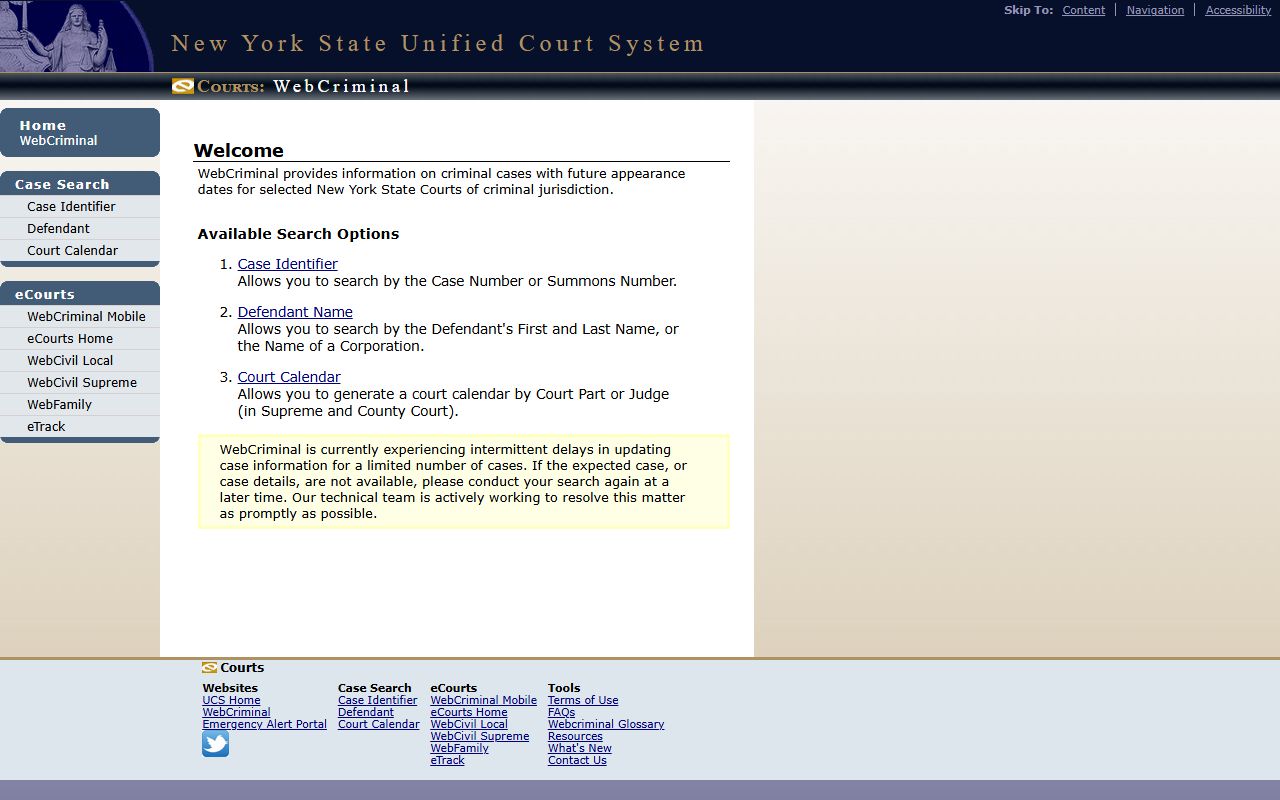
Use the court-search fields to follow the criminal case after the Tompkins County jail arrest, then verify older, sealed, or completed matters with the proper clerk or OCA channel.
WebCriminal Search Fields for Tompkins County Cases
WebCriminal works best when the searcher knows whether they are looking for a case number, a person, or a court calendar. The public NY Courts WebCriminal entry page presents these search modes.
| Field or Mode | Type | Required | How to Use It |
|---|---|---|---|
| Case Identifier | Search mode | One mode required | Use a docket, ticket, or case identifier from court paperwork when known. |
| Defendant | Search mode | One mode required | Search by defendant name when the case number is not available. |
| Court Calendar | Search mode | One mode required | Search a court calendar by court and date where calendar information is available. |
| WebCriminal Mobile | Navigation link | No | Use the mobile interface when searching from a phone. |
| eCourts links | Navigation links | No | Related links include WebCivil Local, WebCivil Supreme, WebFamily, and eTrack. |
Charging Documents After a Jail Arrest
After an arrest and booking, the legal accusation must be carried into court through a charging document. The specific document depends on the offense level and procedural stage. In Tompkins County, the District Attorney reviews and prosecutes state-law offenses committed in the county, while local criminal courts handle arraignment and case processing. The filed court record can be narrower, broader, or different from the booking allegation listed at intake.
| Document | Who Uses It | Common Role | What to Check |
|---|---|---|---|
| Complaint | Police, complainant, or prosecution depending on the case | Begins or supports a criminal case based on alleged facts after arrest. | Read the factual allegation, named offense, court, and date filed. |
| Information | Prosecutor or court-filed accusatory process | Can support prosecution of certain non-felony charges when legally sufficient. | Check whether the charge replaced, refined, or continued the original allegation. |
| Indictment | Grand jury and prosecution | Formal felony charging document for more serious prosecuted matters. | Confirm the indictment count, felony level, and any superseding case history. |
Tompkins County's District Attorney page emphasizes prosecution of New York criminal offenses committed in the county and also notes a progressive strategy that includes diversion and alternatives to incarceration. That policy context does not erase the court record, but it helps explain why some arrests move into reduced charges, treatment-oriented dispositions, or other non-jail outcomes.
Charge Status in Court Records After an Arrest
Charge status can change several times after a jail arrest. A roster or booking note, if released, may reflect the arresting officer's intake allegation. The court file reflects what the prosecutor files and what the judge accepts or dismisses as the case moves. When comparing Tompkins County records, treat jail custody information, WebCriminal entries, clerk files, and OCA criminal-history results as related but separate record sources.
| Status | What It Means | Tompkins County Search Note |
|---|---|---|
| Pending | The charge remains open and the case has not reached final disposition. | WebCriminal may show a future appearance when the case is active. |
| Amended | The filed charge has been changed by later court or prosecutor action. | Compare later court entries with the arrest or booking allegation. |
| Reduced | The case proceeds on a lower charge than the original allegation. | Diversion, plea negotiation, or legal review can change the charge level. |
| Dismissed | The court has ended the charge without a conviction on that count. | Dismissal can affect public access and may trigger sealing rules when the case terminates favorably. |
| Superseded | A later complaint, information, or indictment replaces earlier charging paperwork. | Look for the newer case or count rather than relying on the first filing. |
| Disposed | The charge has reached a final outcome, such as plea, verdict, dismissal, or other disposition. | Completed cases may require clerk or OCA channels rather than WebCriminal. |
Bail, Release, and Court Records After Jail Arrest
Bail in Tompkins County is tied to the court case, not just to jail booking. The county's bail page says Corrections can provide the defendant's name, date of birth, court of jurisdiction, judge name, and cash bail amount needed for payment. The Corrections Division phone for this information is (607) 257-5316.
Tompkins County provides several payment channels. People physically at the jail lobby may use the GovPayNow Pay Bail link, and remote payers may use the Remote Bail link that notifies Corrections for authorization by electronic signature. GovPayNet also accepts phone credit payments at 1-888-604-7888 when the caller has the required payment information. Out-of-town bail money may be wired through Western Union to Tops Supermarket Western Union Office, 2300 N Triphammer Road, Ithaca, NY 14850, payable to the Tompkins County Sheriff's Office.
| Release or Bail Outcome | How It Works | Record Caution |
|---|---|---|
| Release on recognizance | The court releases the defendant without requiring cash bail. | The case can still remain active in court records. |
| Supervised release | The court orders release with supervision conditions where available and lawful. | Release status is not the same as dismissal. |
| Cash bail | A set cash amount must be paid before release from local custody. | The Tompkins page notes a 7 percent GovPayNet fee and later court-release collection rules. |
| Bond forms | Partially secured or unsecured bond forms may be available where legally permitted. | Confirm the exact form with the court or Corrections before payment. |
| Remand or hold | The person remains in custody because bail is unavailable, denied, or blocked by another hold. | Another county warrant, parole or probation hold, federal warrant, immigration issue, or state-ready transfer can prevent release. |
Warrants That Become Jail Arrest and Court Records
No official public Tompkins County Sheriff's active-warrant search or most-wanted list was located in the assigned research. The Sheriff's Civil/Records Division handles service of warrants and other court papers, and the Sheriff's policies reference warrant recordkeeping, but that does not create a public searchable warrant database.
A warrant can still explain why a person was booked at Tompkins County Jail and why release is delayed. An arrest warrant brings a person before court on a criminal matter. A bench warrant often follows failure to appear or violation of a court order. A fugitive warrant or hold can involve another county, another state, or a federal agency. WebCriminal may show a pending case or future court date, but it should not be treated as a warrant-clearance tool. For emergencies call 911; for non-emergency dispatch use (607) 272-2444; for Civil/Records general inquiries use (607) 257-1345 during public office hours.
Charges vs. Convictions in Court Records
An arrest and charge are accusations, not proof of guilt. Tompkins County court records after an arrest may show pending charges before any final decision. A conviction appears only after a guilty plea, verdict, or other qualifying final disposition. That distinction matters for employment, housing, licensing, personal safety decisions, and any attempt to understand a person's criminal-history record.
| Record Point | Charge | Conviction |
|---|---|---|
| Meaning | A formal accusation filed or continued in court. | A final finding or plea that establishes guilt for a specific offense. |
| Timing | Appears early in the case after arrest, arraignment, and prosecutor review. | Appears only after disposition, plea, verdict, or sentence entry. |
| Can Change? | Yes. Charges can be amended, reduced, dismissed, or superseded. | Later appeals, sealing, or post-conviction relief can affect access, but the conviction is a final court outcome. |
| Best Source | WebCriminal for active matters, plus the court clerk for fuller case records. | Clerk records, OCA criminal-history search, or certified disposition records. |
Sealed vs. Expunged Arrest and Court Records
New York public access rules are not the same as a simple public-records request. Public Officers Law Article 6, known as FOIL, creates access to agency records unless an exemption or another statute limits release. Criminal Procedure Law section 160.50 requires sealing of official records after a criminal action terminates in favor of the accused. That can sharply limit public access after dismissal, acquittal, or another favorable termination.
| Record Treatment | Sealed | Expunged |
|---|---|---|
| Plain-English Effect | Official records are hidden from ordinary public access under the applicable sealing rule. | The record is destroyed or treated as though it no longer exists only where a specific law allows that result. |
| New York Arrest Context | CPL 160.50 is the key Tompkins County reference after a favorable termination. | New York sealing is the more common concept in the assigned research; do not assume a routine expungement remedy. |
| Law-Enforcement Access | Some official access may remain for limited legal purposes. | Access depends on the particular statute or court order, if any. |
| Public Request Impact | FOIL can be denied or limited when records are sealed, private, or law-enforcement sensitive. | A public requester should not expect expunged material to be produced. |
CPL 160.10 also matters because it authorizes fingerprints, palmprints, and photographs in specified arrest situations. It explains why booking photographs can be taken, but it is not a blanket rule requiring Tompkins County to publish booking photos online.
Public Access Limits for Court Records After an Arrest
Tompkins County records access often requires matching the request to the record holder. Current custody questions go to Corrections at (607) 257-5316. Releasable county records can be requested through the Tompkins County JustFOIA portal or by mail to Tompkins County, c/o FOIL Request, 125 East Court Street, Ithaca, NY 14850. FOIL questions use (607) 274-5546. Police reports are handled through Sheriff's Civil/Records and usually are not available for at least 3 to 5 business days; the research notes .25 per page for reports, $2 per photo, cash-based transactions, valid ID, and a named-in-report pickup rule.
For court files, the County Clerk at 320 N. Tioga St. maintains Supreme and County Court files, including criminal felony cases. The Tompkins County felony-name index is not open to the public. The research lists a search fee of $5 for every two-year period or fraction, so a seven-year search is $20 per name, and the fee must accompany the request. Ithaca City Court states that criminal-history searches are conducted by the Office of Court Administration Criminal History Search Unit in New York City, with a $95 per-name cost, rather than by the local court.
Records limit: Juvenile matters, sealed cases, favorable terminations, privacy exemptions, and law-enforcement-sensitive records can be withheld even when a related arrest or court event once existed.
Tompkins County Court and Clerk Contacts
Use the court record holder, not the jail, for case documents and certified dispositions. Tompkins County Court is at 320 N Tioga Street, Ithaca, NY 14850. The NY Courts page lists phone 607-216-6610 and fax 212-401-9071, with Chief Clerk Kimberly Record and Deputy Chief Clerk Lindsey M. Chaffee. Courthouse visitors must pass through a magnetometer.
Ithaca City Court is at 118 East Clinton St, Ithaca, NY 14850, phone 607-216-6660, fax 607-240-5821, and email IthacaCityCourt@nycourts.gov. The listed hours are Monday through Friday, 8:30 AM to 4:30 PM, closed for lunch from 12:00 PM to 1:00 PM. The research notes criminal matters on Wednesday and Friday at 9:00 AM, DWI Part on the second and fourth Thursday at 1:30 PM, misdemeanor traffic on Wednesday at 10:30 AM, and other traffic on Wednesday at 11:00 AM.
Background Check Use of Arrest and Court Records
Casual public lookups are different from regulated background checks. A person viewing Tompkins County court records after an arrest should separate accusations from convictions, check whether the case is pending or disposed, and avoid using sealed or incomplete information outside the limits of law. For employment, tenant screening, insurance, credit, and other regulated decisions, use a compliant consumer-reporting process rather than informal court or jail searches.
Important: Informal public-record results are not FCRA consumer reports and may not be used for FCRA-covered eligibility decisions.